Health & Wellbeing Policy
Please read in conjunction with the Assessment Policy & the Special Educational Needs Policy.
St Matthew’s N.S. offers a happy, safe and caring environment. We have a unique family atmosphere where each child is valued as an individual. We encourage a love of learning and promote a child’s natural curiosity through varying challenges, experiences and opportunities. As a small school we foster a respect for other people and their beliefs.
Our aim is that children in our school will develop the self-esteem, awareness and self-confidence to play an active part in school life and be valuable members of their communities.
DEFINITIONS
‘Children and young people feeling good, feeling that their life is going well and feeling able to get on with their daily lives.’
‘Emotional health and wellbeing is the emotional resilience that enables us to enjoy life and to survive pain, suffering and disappointment. It is a positive sense of wellbeing and an underlying belief in our own worth of others. Emotional health and wellbeing is embedded in social relations built upon social skills that are developed from birth.’ (Elizabeth Hartley-Brewer, 2001)
‘Wellbeing is present when a person realises their potential, is resilient in dealing with the normal stresses of their life, takes care of their physical wellbeing and has a sense of purpose, connection and belonging to a wider community. It is a fluid way of being and needs nurturing throughout life.’ (World Health Organisation (WHO), 2001).
The Education Act (1998) states that: ‘A recognised school shall promote the moral, spiritual, social and personal development of students and provide health education for them, in consultation with their parents, having regard to the characteristic spirit of the school.’
WHAT IS ‘GOOD’ EMOTIONAL HEALTH AND WELLBEING IN OUR SCHOOL?
The ability to recognise, acknowledge and manage feelings
The ability to develop care and concern for others
The ability to develop meaningful, positive and long lasting relationships
The ability to take responsibility for oneself and make practical decisions for all in our school
Be effective and successful learners
Make and sustain friendships
Deal with and resolve conflict effectively and fairly
Solve problems with others for themselves
Manage strong feelings such as frustration, anger and anxiety age appropriately
Be able to promote calm, optimistic states that support the achievement of goals
Recover from setbacks and persist in the face of difficulties
Work and play cooperatively
Compete fairly and win and lose with dignity and respect for other competitors
Recognise and stand up for their rights and the rights of others
Understand and value the differences and commonalities between people, respecting the rights of others to have beliefs and values different to their own
The emotional health and well-being of all members of our school is fundamental to our philosophy and aims. Our policies and practices are founded in the development and sustenance of a happy, healthy school, where all learning can flourish. When a school promotes positive emotional health and wellbeing, pupils can better understand and express their feelings. This builds their confidence and emotional resilience and therefore their capacity to learn.
The role of the school is now understood as a place which develops the ‘whole child’, who should leave school with a balanced set of cognitive, social and emotional skills to face the challenges of the 21st century (OECD 2014).
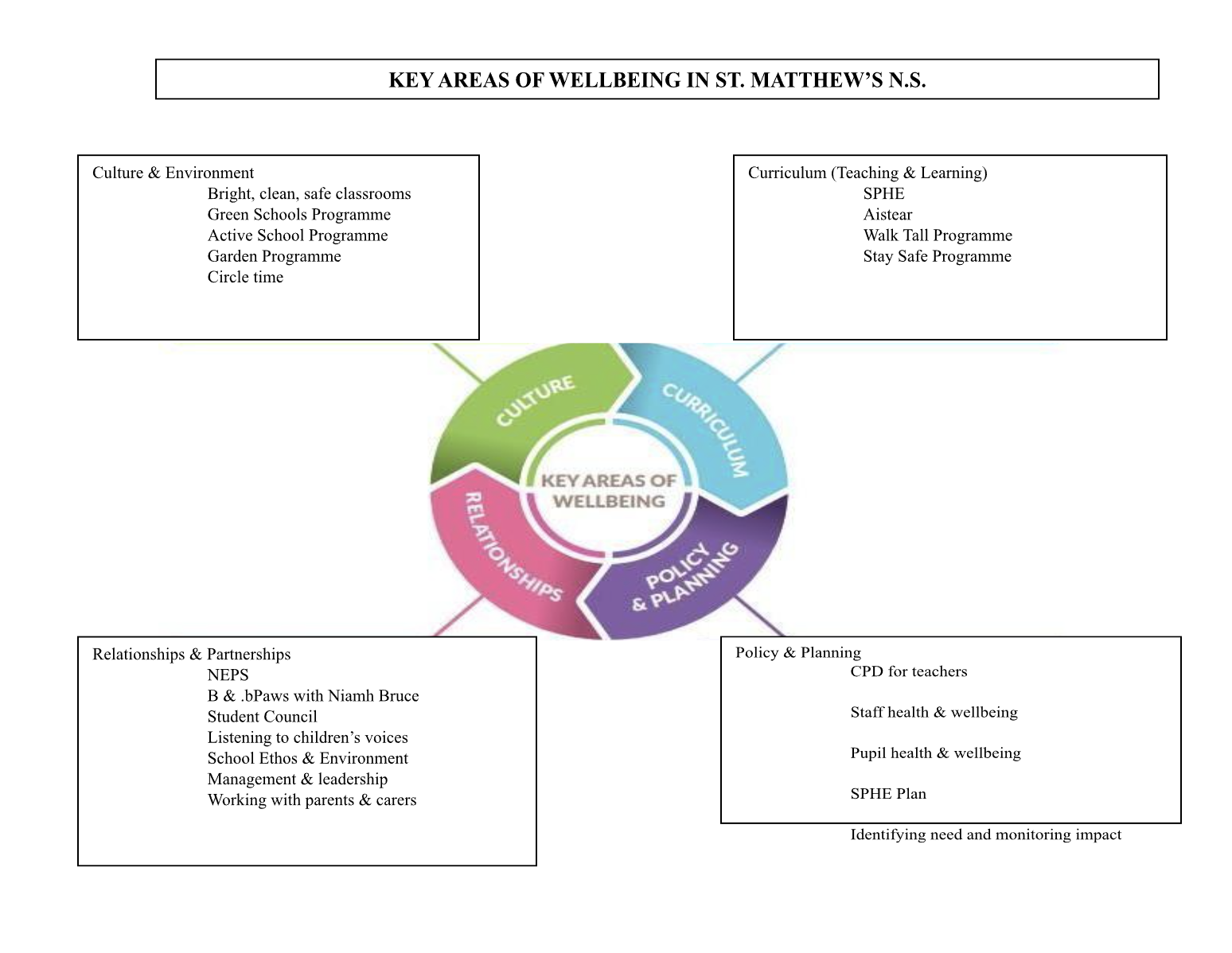
In St Matthew’s N.S. we want to work on the following 8 core principles to ensure our students have support through tough times and know how to handle difficult periods in their lives now and in the future:
Management and leadership
The school ethos and environment
Curriculum, teaching and learning
Student voice
Staff development, health and wellbeing
Identifying need and monitoring impact
Working with parents and carers
Coordinated support
If the 8 principles are consistently and comprehensively applied across the whole school setting they can have a positive impact on:
The cognitive development of children, their learning, motivation and sense of commitment and connectedness with learning and with school.
Staff wellbeing, reduced stress, sickness and absence, improved teaching ability and performance.
Pupil wellbeing including happiness, a sense of purpose, connectedness and meaning.
Development of social and emotional skills and attitudes that promote learning, success, wellbeing and mental health, in school and throughout life.
The prevention and reduction of mental ill health such as depression, anxiety and stress
Improving school behaviour, including reduction in low-level disruption, incidents, fights, bullying, exclusions and absence.
Reducing risky behaviour, such as impulsiveness, uncontrolled anger, violence, bullying and crime.
Emotional health and well-being cover the spectrum of activities in school and the range of educational and health/welfare agencies who support our children. Our school is proactive in its approach and welcomes opportunities to promote emotional health and wellbeing through the formal and informal curriculum. Staff use a variety of methods for ensuring sound emotional health and well-being for children. These complement and reflect the overall aims and philosophy of the school.
Our approach includes:
Class codes of conduct
Clearly identified rewards and sanctions, understood by all
Rewarding positive behaviour and achievement
Positive growth mindset
Setting appropriately challenging tasks
Encouraging co-operation and collaboration
Developing social competence
Encouraging and developing coping strategies and resilience
The school places emphasis on problem-solving, positive self-assessment, time for reflection, quality feedback and encouragement to participate in school and community events.
The delivery of personal, social and health education and citizenship is fundamental to our promotion of emotional health.
We also promote emotional health and wellbeing through values which are embedded into all our learning: respect, responsibility, compassion, creativity, forgiveness, generosity, hope, humility, friendship, justice, courage, peace, trust, perseverance, service, truthfulness, wisdom and thankfulness.
The National Educational Psychological Service (NEPS) supports our school to promote the wellbeing and mental health of all children and young people. While supporting all, NEPS prioritises support for those at risk of educational disadvantage and those with special educational needs. In line with best practice, NEPS encourages schools to adopt a whole school, continuum of support approach to provide for children and young people’s wellbeing needs (DES & NEPS, 2007, 2010a, 2010b). This involves three levels: Support for All, Support for Some and Support for Few.
Provision across the school is monitored by the Principal and the health and well-being committee. Regular staff meetings provide regular opportunities for the quality of care to be evaluated and developed.